
Detection Is Not the Problem. Tracking Is. What Stealth Actually Exploits — and What It Doesn't.
Why the HAWK missile system is still the best teacher in air defense — and what it reveals about modern stealth that most analysts miss.

Stealth Doesn’t Make You Invisible. It Makes You Unlockable.
Let me tell you something counterintuitive.
The best way to understand a modern integrated air defense system isn’t to study a modern integrated air defense system.
It’s to study a HAWK.
https://commons.wikimedia.org/
.jpg)
The MIM-23 HAWK is old. Embarrassingly old — first deployed in the 1960s. And yet as of this writing, it is still actively engaging targets in Ukraine. That alone should tell you something.
What makes the HAWK worth obsessing over isn’t its age. It’s its architecture.
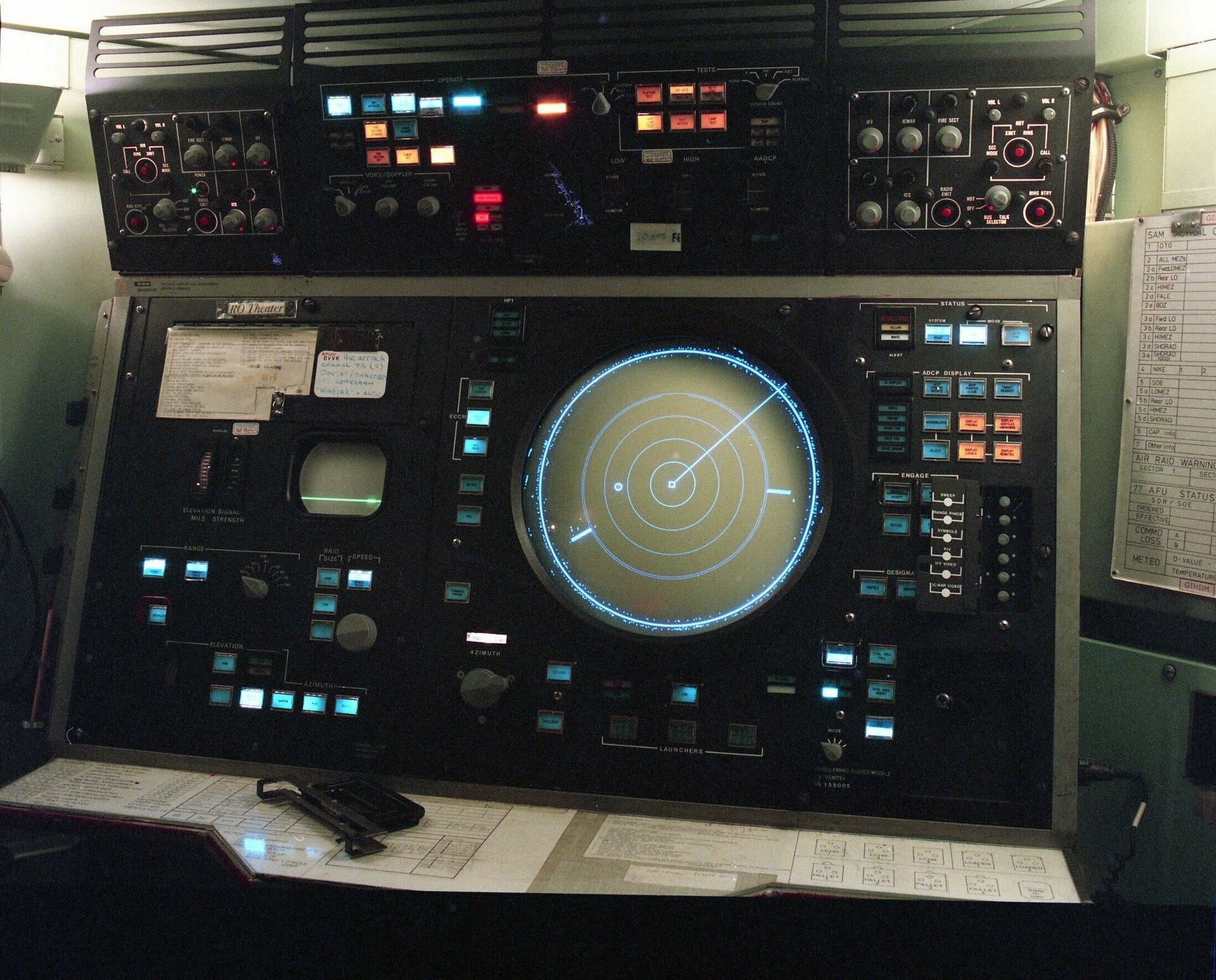
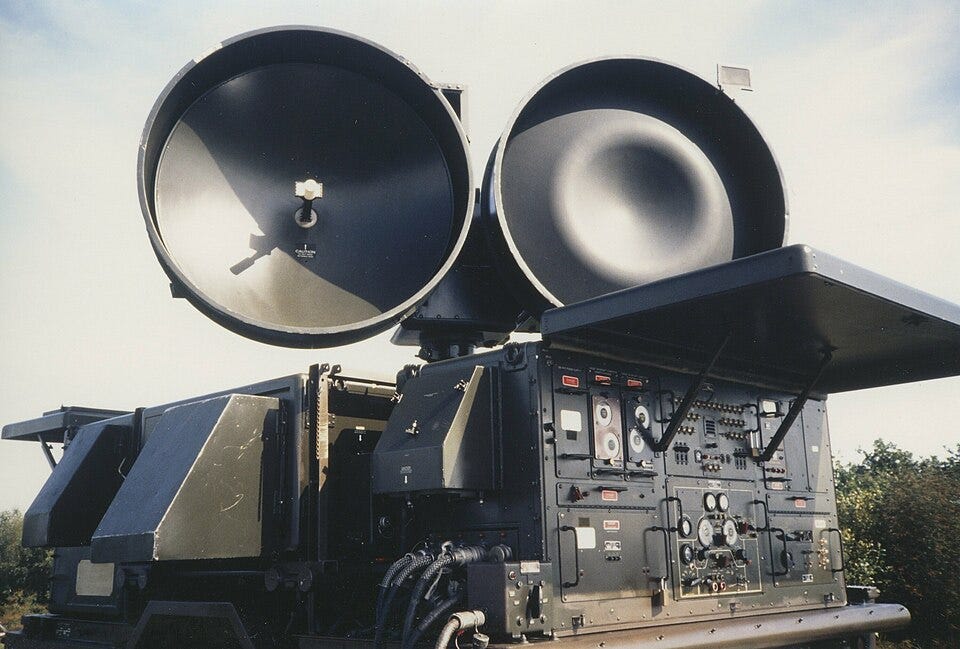
A HAWK battery doesn’t have one radar. It has four distinct systems doing four distinct jobs:
A Pulse Acquisition Radar (PAR) — spinning, searching, finding things at medium and high altitude
A Continuous Wave Acquisition Radar (CWAR) — a Doppler search radar for low-altitude threats hugging the terrain
Two High Power Illuminators (HPIR) — which track designated targets and bathe them in continuous wave energy so the missile’s seeker has something to chase
A Range Only Radar (ROR) — a backup that kicks in when everything else is being jammed
Each system knows its job. Each system knows almost nothing about the others. The Battery Control Center is the only thing that sees the whole picture.
This separation is not a design flaw. It is the design. And once you understand why, everything about modern air defense — and modern stealth — clicks into place.
The HAWK is a system where the seams are visible.
You can trace a contact appearing on the PAR. Watch the CWAR confirm it at low altitude. Watch the HPIR slew over, lock on, and begin illuminating. Watch the missile lift off and chase the reflected signal home — what the technical manuals call semiactive radar homing, the missile continuously comparing the HPIR’s transmitted signal against what’s bouncing back from the target.
You can also see exactly where the chain breaks.
No return from the illuminator. Track lost. Missile goes dumb.
That image — the missile going dumb — is the key to understanding everything that has happened in air defense in the last forty years.
The deeper you go into HAWK documentation, the more you realize: this isn’t just an old system. It’s a diagram. A physical, mechanical, brutally honest diagram of what every air defense system — no matter how modern — is actually trying to do.
Everyone uses the word “invisible” when they talk about stealth.
That’s the wrong word. And it leads to the wrong conclusions.
Here is what stealth actually does.
Modern stealth aircraft — the F-22, F-35, B-21 — are optimized to reduce their radar cross-section specifically in the X-band: the high-frequency, short-wavelength radar range where fire control systems operate. The X-band is where you get the resolution and precision required for what defense engineers call weapons-grade tracking — the kind of lock that lets you guide a missile to an intercept point.
Stealth doesn’t make an aircraft disappear from every radar. It makes the aircraft’s signature fall below the threshold where X-band fire control can maintain a stable track.
The acquisition radar may pick something up — intermittent, unstable, hard to hold. Enough to know something is probably there. Not enough to hand off to fire control.
The HPIR fires. The return is too weak, too inconsistent. A stable track file never forms.
No stable track means no lock-on.
No lock-on means the missile has no destination.
Detection without a weapons-grade track is a warning. Not a weapon.
Here is where studying the HAWK pays off in ways that studying modern systems simply cannot.
In the HAWK’s architecture, these are separate, physical, visible steps. Acquisition here. Track here. Illumination here. Launch here. The chain has visible links. You can see where it could break — because each break point is a different box, a different antenna, a different job.
Modern integrated systems — phased array, AESA — compress all of this into milliseconds. The functions are still there: search, track, fire control, guidance. But in an AESA radar, they run as software on a single aperture, with the beam steering electronically at speeds no mechanical system can match. The seams are still there. They’re just invisible — running in code, hidden by speed and integration.
Anyone studying only modern systems understands that it works. Very few understand why it can fail.
Stealth exploits the failure points. And if you’ve never seen the seams, you don’t know where to look.
There are three serious approaches to breaking stealth’s hold on the kill chain. Each attacks a different assumption.
Low-frequency radar.
Long-wavelength VHF and UHF radar interacts differently with stealth geometry. When the radar wavelength approaches the size of the aircraft or its components, resonance scattering increases the return significantly. Systems like Russia’s Nebo-M and China’s JY-26 are built around this principle — the Nebo-M reportedly capable of detecting the F-35 at ranges over 1,000 kilometers. Detection here means only that something may exist in that general direction — not identification, not tracking, and nowhere near lock-on
The problem is resolution. Long wavelengths give poor angular and range accuracy. You can see a direction. You can see that something is probably there. You cannot build a weapons-grade track. Detection without targeting is still just a warning.
The arms race here is in signal processing — whether digital advances can eventually squeeze targeting-quality resolution out of long-wavelength returns. Russia and China have invested heavily in this since the Gulf War. The jury is still out.
Infrared.
Heat is harder to suppress than radar reflection. A stealth aircraft is still burning fuel, still generating exhaust, still radiating thermal signature. IR-guided systems don’t care about RCS. Some European HAWK variants were upgraded with an electro-optical sensor (HEOS) for exactly this reason — passive IR acquisition as a supplement to radar illumination.
The limits are range and countermeasures. Flares work. Altitude and speed work. But the vector exists, and at shorter ranges it becomes increasingly relevant — particularly as IR sensor technology improves.
Multistatic radar.
This is the one that matters most right now.
Conventional radar — monostatic — puts the transmitter and receiver in the same place. Stealth geometry is designed to scatter incoming radar energy away from the source. The transmitter sends; very little comes back.
Multistatic radar separates the transmitter and receiver, sometimes by large distances. The target doesn’t need to reflect energy back toward the source. It only needs to scatter energy somewhere — and if a receiver is positioned to catch that scatter, the geometric assumptions of stealth start to collapse.
India’s DRDO is actively developing multistatic radar specifically to counter J-20 and J-31 stealth platforms. Research published in 2025 demonstrated that passive radar — using digital audio broadcast signals as illuminators, with no dedicated transmitter at all — could reliably track small UAVs once advanced signal processing was applied.
The architecture is the threat to stealth designers. It doesn’t change the physics. It works around them.
So is a concept built into a 1960s system still valid in 2025?
Mostly, yes.
The physics didn’t change. The kill chain logic didn’t change. What changed is implementation speed and integration depth — phased arrays instead of spinning dishes, software-defined functions instead of separate hardware boxes, millisecond response times instead of operator handoffs.
The HAWK makes clear that detection and tracking are fundamentally different problems. That a missile needs a stable return to follow home. That breaking one link in the kill chain is enough — whether you break it at the tracking stage or the lock-on stage makes little practical difference to the pilot on the other end.
None of that is obsolete.
If you understand why a HAWK battery needed four separate radar systems to kill one target, you understand why stealth works.
And you understand exactly what it would take to make it stop working.
That’s not something you learn from a YouTube video.
It’s not something you learn from reading about modern integrated systems, either. Modern systems are too clean. Too fast. Too seamless to reveal their own logic.
You learn it by going deep on the dinosaur — by tracing every cable, every handoff, every moment where one box finishes its job and passes the problem to the next one.
The technology got faster.
The physics stayed the same.
The HAWK just makes that impossible to ignore.
This piece draws exclusively on concepts documented in open-source literature.
If this kind of breakdown is your thing — the mechanics behind the headlines, the physics underneath the strategy — there's more where this came from. Next up: four different ways to kill an aircraft, four completely different philosophies, and what happens when you've actually watched all of them work. The equipment gets older. The problems stay the same. That's what makes it interesting.
All technical details in this piece are drawn from publicly available U.S. sources. If you want to go deeper, the documentation is there.
GlobalSecurity.org: HAWK Radar Systems · HAWK Specifications · HAWK Operations Manual
FAS.org: HAWK Historical Context
Wikipedia: MIM-23 HAWK
Designation-Systems.net: PAR, CWAR, HPI, ROR Technical Specs
https://seoulinside.substack.com/p/detection-is-not-the-problem-tracking
https://seoulinside.substack.com/p/the-kf-21-is-not-a-stealth-fighter
https://seoulinside.substack.com/p/kf-21-boramae-why-the-stealth-debate
https://seoulinside.substack.com/p/part-4-the-blind-side-why-north-koreas
https://seoulinside.substack.com/p/part-5-one-aircraft-two-roles-why